

Situations
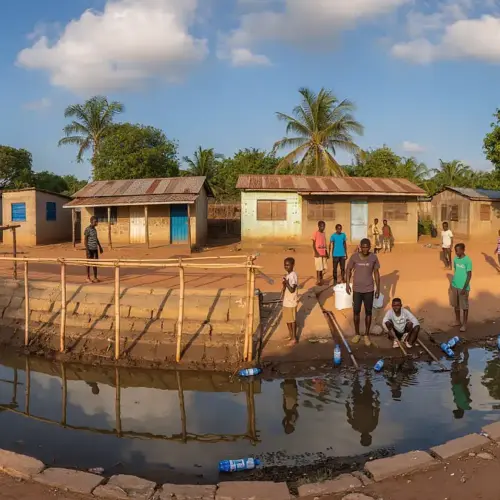
In many areas, waste doesn’t “go away” — because there is no dependable system to take it away. No predictable pickup route. No consistent disposal management. No accessible sorting points. The result is simple: waste stays inside the community, spreading from household corners to footpaths, wetlands, drains, and waterways.
This is why unmanaged waste is not primarily a “behavior problem.” It’s an infrastructure gap. When a working system is missing, people default to the only options available — dumping, burying, or burning — because daily life cannot wait for solutions that don’t exist.
At Bamboo Foundation Gambia, our focus is practical and scalable: we build stepping stones that communities can operate in real life — collection routines, support for local collectors, and simple drop-off/sorting concepts that can expand with partners and measurable milestones.
Key idea: without a system, waste becomes a daily emergency
A missing collection system doesn’t just create “mess.” It creates a constant pressure point:
- Households run out of safe choices.
- Drains clog faster than they can be cleared.
- Smoke and pests become normalized.
- Communities stay stuck in reaction mode.
The tragedy is that people often do care — but caring doesn’t remove waste. A routine does.
What “no collection” looks like on the ground
When there’s no reliable infrastructure, a predictable pattern appears:
1) Hotspots become permanent
Informal dumping corners form near drainage lines, behind houses, at dead-end streets, and along footpaths. Once a hotspot exists, it attracts more dumping — because it becomes the “accepted place.”
2) Rain turns waste into flooding fuel
Plastic and mixed waste travel with runoff. What starts as a pile becomes a moving blockage. Culverts and channels choke, water backs up, and flooding hits the same vulnerable areas again and again.
3) Burning becomes the “fast solution”
When waste piles grow, open burning feels like the quickest way to reduce volume. But it trades one crisis for another — air pollution and health exposure, especially for children and older people.
4) Community trust erodes
If cleanups don’t last, people stop believing improvement is possible. That loss of trust is invisible — and extremely expensive to rebuild.
Why systems don’t exist (yet) — and why that matters
It’s rarely one single issue. Usually it’s a combination:
- limited municipal capacity and budgets
- rapid growth of single-use packaging
- long distances to formal disposal routes
- lack of local drop-off points
- weak “value chain” incentives for recovery
The outcome is the same: the community becomes the last resort. And “last resort” solutions repeat every week.
What actually works: small systems that repeat
When people say “we need infrastructure,” they often imagine trucks and big facilities. Those are important — but communities can’t wait for perfect.
In reality, reliability starts smaller:
- a predictable collection rhythm (even if it’s local and basic)
- a clear drop-off point people can use
- simple separation (2–3 categories is enough to start)
- safe storage that prevents re-scatter and drain blockage
- local coordination so the routine survives beyond one event
That’s the difference between a campaign and a system.
Our direction: stepping stones that can grow
We build a workable “first layer” that communities can run — then strengthen it with partners.
1) Collection days that turn into routines
Collection days work only if they repeat. The goal is to build a predictable rhythm:
- focus on the same priority zones (drains, hotspots, schools, waterways)
- use the same workflow (collect → separate → store → move)
- document consistently (so progress is visible and accountable)
When the rhythm exists, behavior changes without constant pressure.
2) Support for local collectors (the missing middle)
Local collectors often keep waste moving — even informally. With the right support, they become the backbone of reliability:
- PPE and durable sacks
- handcarts/wheelbarrows or light transport support
- stable sorting/drop-off points
- basic training (safe handling, separation, documentation)
For partners, this is a clean entry point: tangible inputs → measurable outputs.
3) Simple drop-off + sorting points that fit real conditions
A sorting point doesn’t need to look like an industrial facility. It needs to work under sun and rain:
- a shaded area and basic structure
- color-coded sacks (no text required)
- safe storage to prevent re-scatter
- a coordinator role to keep the system running
A small, well-run drop-off point can change the waste flow of an entire neighborhood — especially around drains.
What we measure (so it doesn’t become “good intentions”)
Impact has to be trackable, or the system drifts back to chaos. We focus on metrics that are realistic to maintain:
- number of collection days completed (per month)
- kg of mixed waste and plastic collected (by area)
- number of drop-off/sorting points established and maintained
- meters of drainage cleared and kept clear over time
- number of collectors/coordinators trained and active
- before/after documentation of recurring hotspots
- reduction of re-scatter at priority points (spot checks)
These indicators show whether reliability is improving — not just whether a single cleanup happened.
Where bamboo fits (honest and useful)
Bamboo doesn’t replace municipal waste infrastructure. But it can support the stepping-stone model in two practical ways:
Bamboo supports low-cost local setup
Simple bamboo structures can provide:
- shade and shelter for sorting points
- racks for organizing sacks and tools
- storage that keeps materials off the ground and out of drains
- durable baskets/handling solutions for collection routines
Bamboo supports local value and capacity
Long-term reliability improves when communities gain skills and income pathways. Bamboo-based training and livelihoods can strengthen local capacity — which helps environmental routines survive beyond short-term funding.
How you can support (clear entry points)
For private donors
Your support funds the practical basics that make reliability possible:
- sacks, gloves, rakes, basic sorting equipment
- transport support for routine collections
- safe storage to prevent re-scatter
- coordinator support so routines don’t collapse
- education linked directly to action
For CSR partners
This is one of the most structured partnership areas because deliverables are concrete:
- equip local collection teams (PPE, sacks, carts, toolkits)
- sponsor a scheduled collection program with KPIs
- set up a pilot drop-off/sorting point with milestones
- fund collector/coordinator training with documentation
- build an impact reporting package (KPIs, photo logs, short case stories)
If you want measurable progress fast, reliability in collection is a direct lever.
The bottom line
When collection infrastructure is unreliable or missing, dumping and burning become the default — not because people don’t care, but because the system gives them no workable alternative. The solution isn’t a lecture. The solution is a small system that repeats: collection, simple sorting, safe storage, local coordination, and basic reporting.
And yes — the road is long. But Bamboo Foundation Gambia is one small, practical path to move things forward — one routine, one community, one measurable step at a time.